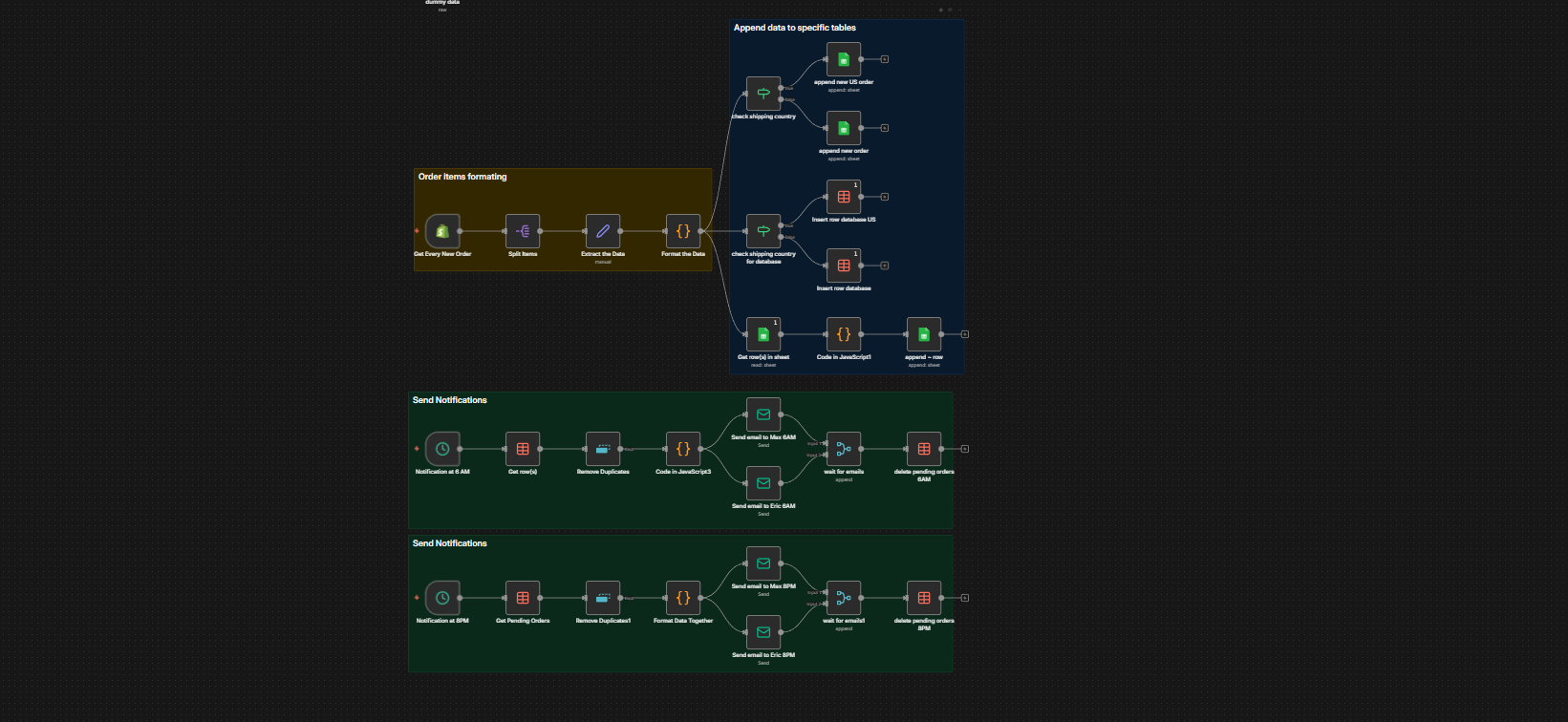
From Manual Orders to Reliable Handoffs
A growing Shopify store needed orders to reach production without copying, reformatting, or manual follow-up.
The Result Summarized
- ⏱ Cut order handling time by 62%
- ❌ Eliminated fulfillment interpretation errors
- 📦 Standardized dispatch across EU & US
- 🔔 Auto-notified the fulfillment team at key moments of the day
The Problem
Manual order handoffs forced the operations team to copy order data between Shopify, spreadsheets, and the fulfillment partner.
Orders were coming in. Products were made in-house. Fulfillment existed.
But every order still required someone to manually extract data from Shopify, interpret product variations, rewrite order details, and pass them to the fulfillment and shipping team.
Nothing was “broken.” Everything was just slow, fragile, and dependent on humans not making mistakes. That’s the danger zone most growing e-commerce stores sit in without realizing it.
The Real Cost Wasn’t Labor. It Was Latency and Errors
Each order triggered a familiar chain of small, manual steps:
- Open the Shopify order
- Read customer and shipping details
- Interpret product variants and line items
- Re-enter everything into a fulfillment document
- Notify the team that a new order exists
Individually, these steps seem harmless. Together, they create:
- Delays before production even starts
- Inconsistent formatting and interpretation of order data
- Missed or late notifications to fulfillment
- Errors that only surface once the order is already in progress
As volume increases, this doesn’t scale linearly.
It compounds. More orders mean more handoffs, more context switching, and more chances for something to slip.
The hidden cost isn’t just time spent typing.
It’s slower dispatch, rework, and the constant background anxiety of “did we miss something?”
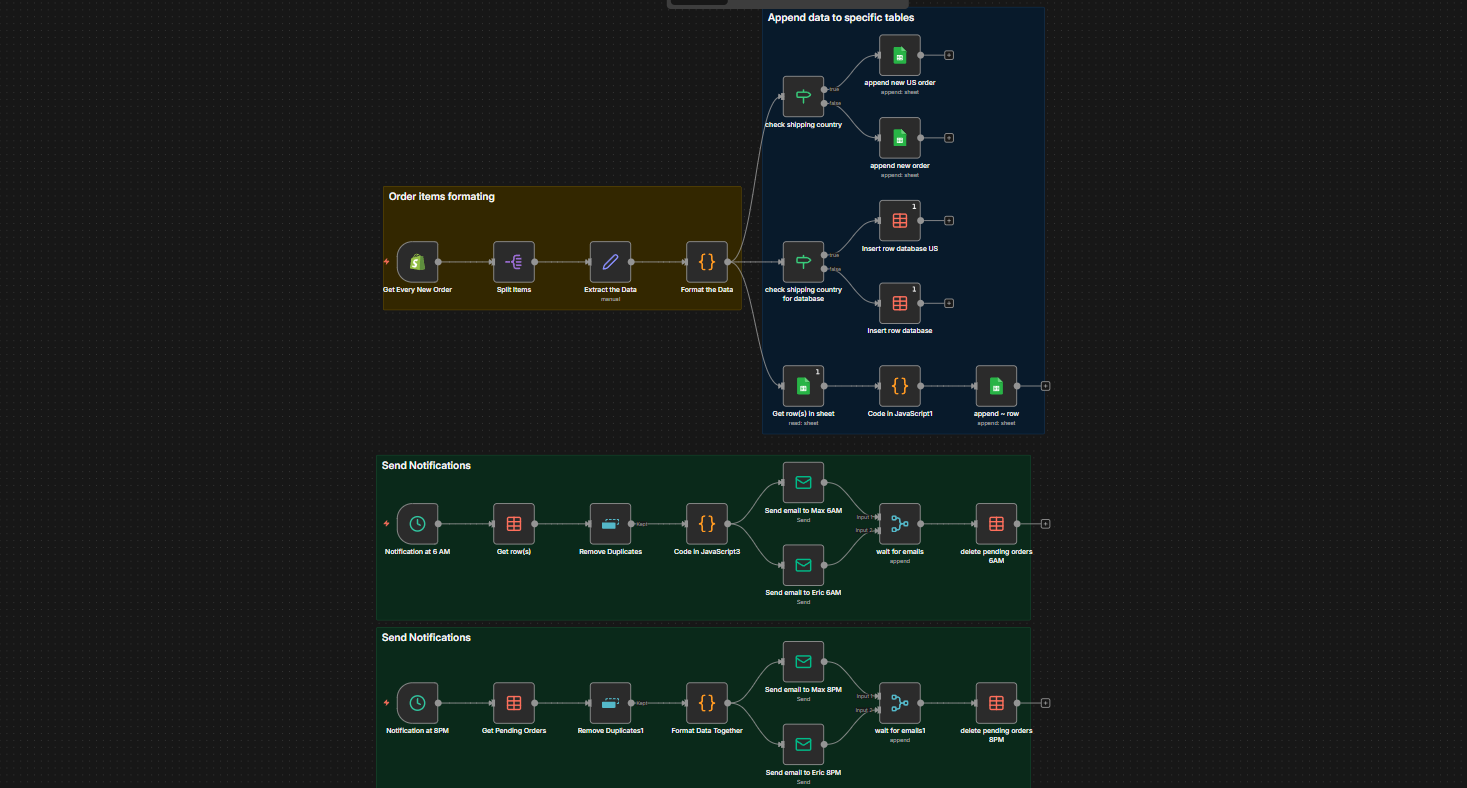
The Solution. The Automation Removed Interpretation From the Process.
The goal wasn’t to make the team “work faster.”
It was to remove judgment, repetition, and ambiguity from order handling entirely.
- The automation now:
- Reads every new Shopify order automatically
- Parses all order line items, product variations, and customer details
- Places clean, structured data into a dedicated Google Sheets system
- Routes orders based on delivery region (EU vs. United States)
- Notifies the fulfillment team at key moments during the day
No one copies data.
No one reformats orders.
No one wonders whether an order was already handled.
The system does the boring, failure-prone work so the team doesn’t have to.
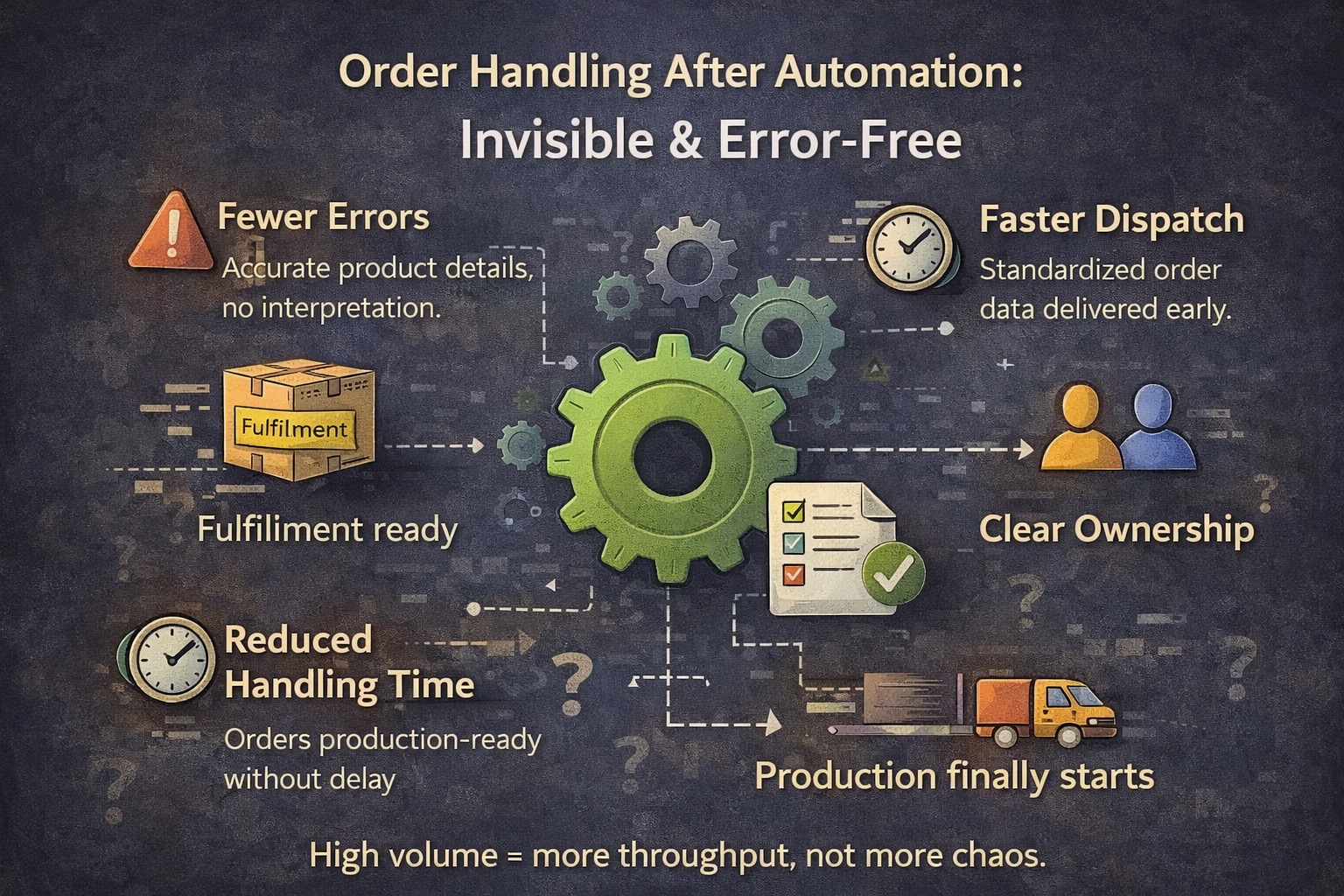
The Result. What Changed Operationally.
After automation, order handling stopped being an activity and became an invisible background process.
Key shifts:
- Fewer fulfillment errors
Product variants and order details are no longer re-interpreted by humans. What was ordered is what appears in fulfillment. - Reduced order handling time
Orders move from checkout to production readiness without waiting on manual input. - Faster dispatch
Fulfillment receives complete, standardized order data early and consistently, allowing production and shipping to start sooner. - Clear ownership and visibility
Everyone looks at the same source of truth. No private notes. No side messages. No “who handled this?”
Most importantly, the system doesn’t degrade on busy days.
High volume doesn’t increase chaos — it just increases throughput.
Optional Technical Context
The automation connects Shopify order data with structured Google Sheets and timed team notifications.
It filters and routes orders based on delivery region and ensures fulfillment only sees what matters to them, when it matters.
No custom dashboards.
No overengineering.
Just reliable data flow and predictable handoffs.
Does This Process Feel Familiar?
- If your team still:
- Copies order data manually
- Relies on messages or ad-hoc documents to trigger fulfillment
- Handles EU and US orders differently without system support
- Needs “just one more check” before shipping
You’re already paying the cost. It just hasn’t shown up as a line item yet. Manual order handling doesn’t break suddenly. It quietly limits speed, accuracy, and confidence.
Not Sure What to
Automate First?
Show us where work feels slow, repetitive, or fragile. We will help you identify the strongest first automation opportunity.